
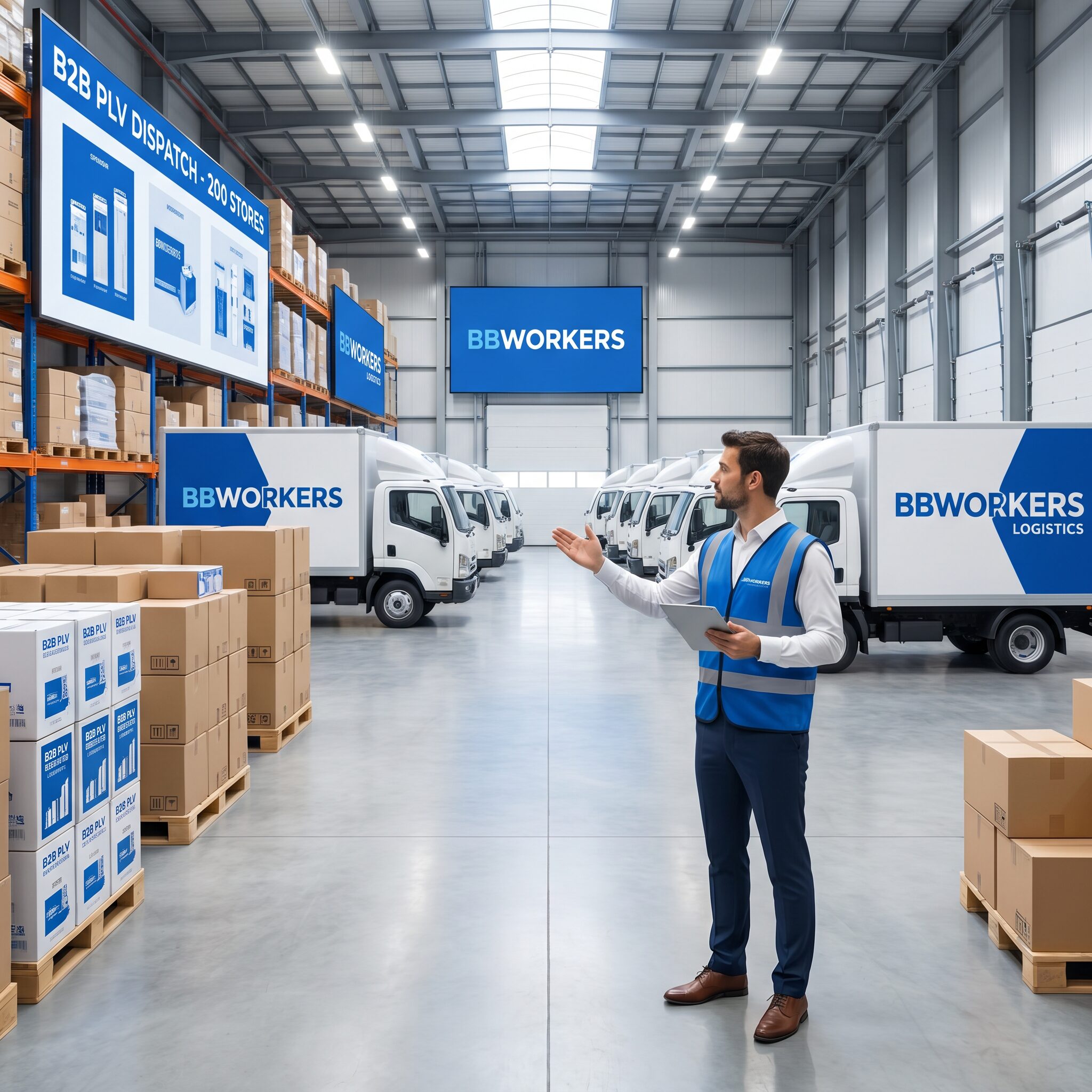
On a franchise network, a POS campaign rarely fails at the printing stage. It fails at delivery. Posters land the day after launch. One store receives the kit meant for another. A shop in a pedestrian zone has no confirmed delivery window, and the logistics lead spends launch day answering calls from the field.
The pattern repeats whenever POS dispatch is treated as an extension of production: a carrier collects pallets and moves them from one place to another. That is shipping, not dispatch. Dispatch is a coordination job, and it has to be designed before anything leaves the warehouse.
what is POS dispatch for a franchise network?
POS dispatch is delivering one complete kit to each store, inside a confirmed window, so the whole network launches on the same day.
It means coordinating many different addresses, many different delivery slots and a single launch date. BBWORKERS brings together 8 brands for franchise networks, and ADL is the group's logistics brand. ADL has run this kind of flow since 2013 from the Bonson site, a 5,400 m² platform where the production of several brands converges before shipment.
what POS dispatch involves in practice
Sending POS material to a network means solving several constraints at once, which general carriers usually handle one at a time.
First, stores do not all carry the same assortment. A fashion network typically runs several store formats. A small city-centre shop does not install the same displays as a large corner in a shopping centre. Dispatch therefore starts at the preparation table, not at the loading dock.
Second, delivery windows rarely match standard opening hours. A shop in a pedestrian zone may only be reachable early in the morning. Another is closed on Mondays. A third opens late.
Third, the reception date has to be identical across the network. The campaign goes up on the same day whether the store is in Lille or in Marseille.
ADL settles these three constraints upstream of shipping. This is the difference between a deployment measured in days and one measured in weeks, a point developed in our guide to how BBWORKERS organises multi-site campaigns. The speed of the carrier matters far less than the quality of the preparation.
sequenced routing: why pallets do not all leave on the same day
The basic rule is simple: for every store to receive its kit on the same launch day, the pallets cannot all leave the warehouse on the same day.
ADL sequences departures according to distance from Bonson and local delivery constraints:
- first wave: the stores furthest away, such as Brittany, the Riviera or Alsace
- second wave: stores several hours of driving from the platform
- last wave: the Paris region and areas with short transit times
This routing is not an estimate. It relies on a delivery database built campaign after campaign for each network: validated slots per store, the history of regional carriers and permanent constraints such as pedestrian zones, restricted hours and access codes.
During the winter sales of 2026, 245 stores in a fashion network received their kits in successive waves. By the evening of launch day, nearly every store had confirmed reception. The few exceptions, caused by weather in the Alps, an address changed the day before and a pedestrian zone with an exceptional slot, were delivered the next morning before opening.
one kit per store, one assembly sheet, no sorting on arrival
Most providers ship by reference: a pallet of posters, a pallet of displays, a pallet of banners. On arrival the store team has to sort, count and often send surplus items back.
ADL prepares by destination, not by reference. Each parcel or pallet carries the exact store name, the confirmed delivery address, the validated time slot and a visual assembly sheet showing what to install and where.
The materials come from several brands of the group. Promociel produces large-format prints, Présentoirs & Présentoirs supplies the display structures, Textile Direct handles textile printing for flags and banners, and Autosignalétique covers vehicle and exterior signage. They leave Bonson together and are assembled store by store before dispatch. The shop manager opens a single parcel and has nothing to count or return.
Preparing this way also makes store-level personalisation possible without lengthening lead times, because the sorting is done in Bonson and not in the shop. You can see how the brands fit together on the BBWORKERS brands page.
500 coordinated deliveries in 72 h: what it takes on the warehouse side
ADL has handled 500 coordinated deliveries in 72 h at the peak of a campaign. That volume is possible because the Bonson site is vertically integrated: the production flows of the group's brands converge on one perimeter of 5,400 m², which removes transit time between suppliers.
Three factors have to work together:
- synchronised production: the materials come out together, so kits can be assembled continuously without waiting
- a store constraints database: every client network has a maintained file of store surfaces, delivery slots, exact coordinates and vehicle access
- real-time tracking: a reception dashboard lets the sales director follow progress by region and decide quickly when something changes
For a growing network, internal teams cannot absorb this level of complexity with standard tools. If you are planning a rollout, the franchises and networks page explains how the pieces connect from production through to reception.
what to ask of a POS dispatch provider
A few questions separate a logistics partner for POS from a carrier that simply moves volume.
What is your confirmed-reception rate on launch day for recent campaigns? A serious provider tracks this indicator campaign by campaign and measures it on in-store confirmations, not on shipping notes.
How do you handle an address changed the day before? On a large network, a few late changes are statistically certain. The difference lies in whether the provider can re-route in real time without extra cost.
Do you pack by store or by reference? The answer determines most of the workload your field teams absorb on arrival.
To scope a first campaign, contact our teams, or start from our expertise to see how dispatch fits into an end-to-end rollout.
frequently asked questions about POS dispatch
how long should you allow to dispatch POS displays across a large network?
Allow for production first, then for sequenced routing. The total depends on the complexity of the kits and on how far the furthest store is from Bonson. ADL confirms a route plan once the proof is approved, and it is the sequencing that keeps a coordinated delivery wave inside 72 h. A multi-supplier model usually takes far longer because every supplier ships on its own schedule.
how do you avoid missing items when a multi-site POS campaign is delivered?
Shortages mostly appear when parcels are sent by reference instead of by destination, because the store has to sort. Packing by store, with one parcel or pallet per point of sale and a visual assembly sheet, removes that source of error. The second cause, unconfirmed delivery windows, is handled through the constraints database that ADL maintains for each network.
is a single multi-brand pallet per store possible?
Yes, provided the production of all materials is centralised on one site. Within BBWORKERS, Promociel, Présentoirs & Présentoirs and Textile Direct produce in parallel at Bonson, and kits are assembled store by store before shipment. One parcel arrives containing everything, ready to install.

